Commercial-Grade Solar Lighting for Any Project
.svg)
in solar lighting

installed worldwide

weather conditions

.avif)
Trusted to Bring Light Wherever It’s Needed





The Most Cost-Effective Outdoor Lighting Solution
Watch the video to learn more
.svg)
.avif)
No Trenching, No Wiring, No Grid, No Problem.
Conventional outdoor lighting starts below ground — and that's where the cost, delay, and risk start too. FLT skips all of it.
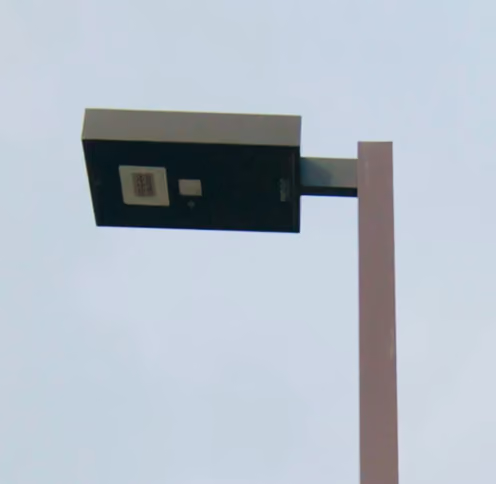
Installs in under 30 minutes
A single person can deploy a unit start to finish, which takes electrical delays off your critical path.

Captures and converts more energy, even in partial shade
Full-surface FLT Active Cell™ panels capture more usable sunlight than standard cells, while FLT ChargeLogic™ converts it efficiently even in shade, cold or low light.

Runs on 2-3 hours of sunlight
Up to 21 days of autonomy without a full charge, compared with the 3–5 days typical of other solar lighting.
Installs in under 30 minutes
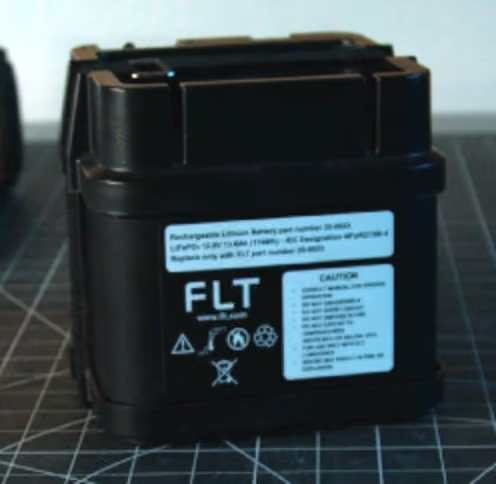
FLT All-Weather™ LiFePO4 chemistry holds up in extreme heat and cold, with 2,000+ charge cycles for 10+ year battery life inside a 20+ year fixture.
Lights itself, dusk to dawn, automatically
FLT Adaptive Intelligence™ manages astronomical lighting profiles and output automatically — with app control and motion sensing available on select fixtures.
Hardwired vs Solar
Compare how our solar technology outperforms hardwired lighting
Factor
Hardwired
Solar
%20(1).avif)

.avif)
“If we were looking at 3,000 linear feet, that would be about $60K in conduit pricing that you don’t have to use anymore with FLT. That’s significant savings.”
Frequently asked questions

FLT solar lights typically cost about 50% less over their lifecycle than traditional AC-powered lighting, since they eliminate trenching, electrical permitting and utility hookup fees entirely. Hardwired systems carry higher long-term costs from both installation and ongoing utility bills, while solar operates with no utility bills at all. The savings scale with project size: the more linear footage of lighting a project needs, the more expensive trenching and electrical work becomes by comparison.
FLT solar lights typically cost about 50% less over their lifecycle than traditional AC-powered lighting, since they eliminate trenching, electrical permitting and utility hookup fees entirely. Hardwired systems carry higher long-term costs from both installation and ongoing utility bills, while solar operates with no utility bills at all. The savings scale with project size: the more linear footage of lighting a project needs, the more expensive trenching and electrical work becomes by comparison.
Most FLT fixtures can be installed by a single person in under 30 minutes, with no electrician or electrical permit required. Since there's no trenching or wiring involved, installation timelines are driven by how many fixtures you're placing, not by electrical infrastructure work. This also means lighting can go in late in a project timeline without holding up other site work.
No. FLT solar lights operate independently of the grid, so no electrical permit or utility connection is required. Each fixture generates and stores its own power on-site, removing the need for trenching, wiring or utility scheduling. This also eliminates a common bottleneck in development timelines, since lighting installation isn't dependent on utility scheduling or inspection sign-off.
Lorem ipsum dolor sit amet, consectetur adipiscing elit. Suspendisse varius enim in eros elementum tristique. Duis cursus, mi quis viverra ornare, eros dolor interdum nulla, ut commodo diam libero vitae erat. Aenean faucibus nibh et justo cursus id rutrum lorem imperdiet. Nunc ut sem vitae risus tristique posuere.
Yes, solar lighting eliminates a major security vulnerability that hardwired systems carry: copper wire theft. Because FLT lights have no exposed copper wiring, there's nothing for thieves to target, unlike traditional hardwired fixtures where buried cable is a frequent theft risk. This also means no blackout vulnerability, since each fixture operates independently of the grid rather than relying on centralized power.
Ready to See the Light?
Let our engineers design a complimentary lighting layout for your specific project