
How Frisco, Colorado
Proved Solar Street Lighting at Scale
125 Custom BFL Deco Solar Lights, $795,000 in Grant Funding: Frisco, Colorado Sets a New Standard for Highway Infrastructure
after going solar
Hwy 9
Overview
BFL Deco Bell Streetlight
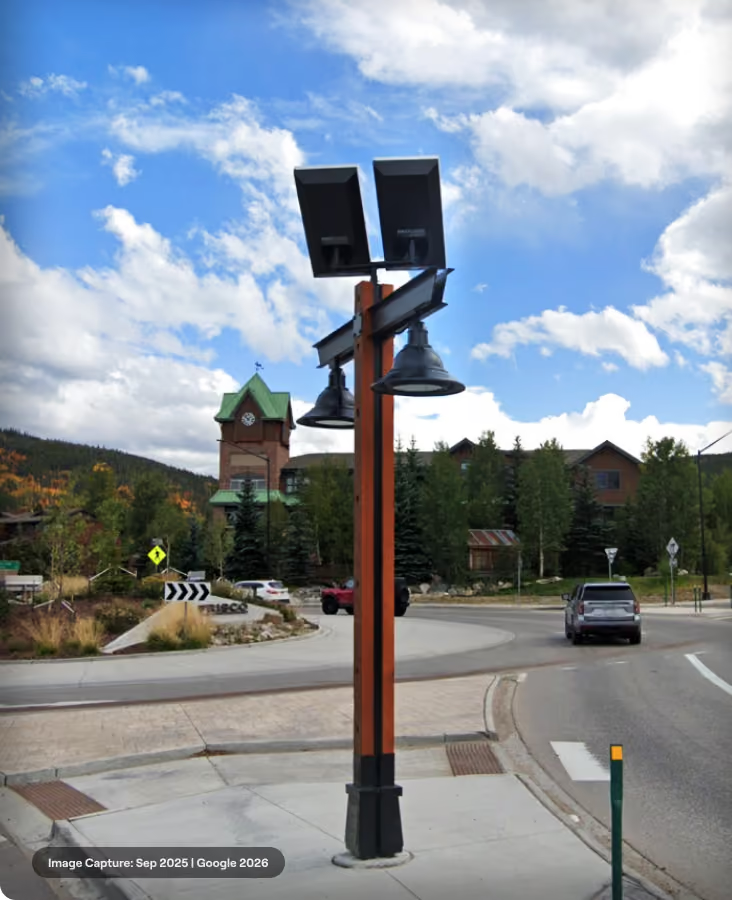
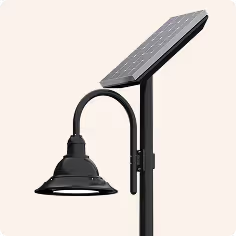
Decorative architectural solar street lighting, built for high performance, full cut-off illumination where aesthetics matter. Custom-ordered on wood poles for the Town of Frisco.
The “Unfortunate Pleasure” of Repulling Wire
Addison Canino, Capital Projects Senior Manager for the Town of Frisco, had experienced what he calls the ‘unfortunate pleasure’ of re-pulling wire on aging A/C median lights on Highway 9. When it came to his attention that the median lights had been absorbing magnesium chloride through Colorado winters, causing steady corrosion over time, he wasn’t keen to work with hardwired lighting again.
Every rewire meant hoping that the conduit below ground was still intact and often discovering that unfortunately it was not.
"It all starts literally below ground and works its way up. There are so many variables when you're installing below-ground infrastructure. We really started to challenge that."
Solar vs. Hardwired: The Pilot That Changed the Calculation
Meadow Creek Park sits in the heart of Frisco, offering a skating pond, playground and a 1,200-foot pathway for locals and visitors alike. When a Request for Proposal (RFP) was issued to light it up, Addison structured one bid for hardwired and one for solar, creating a direct cost comparison from the start. Town council environmental goals, championed vocally by Frisco council member Jesse Burley, had already put solar on the agenda, particularly in areas where new trenching would be required.
The cost-benefit analysis favored clearly on the side of FLT solar lighting. Not just on upfront infrastructure savings where trenching wasn't required, but across the full project lifespan including: maintenance without an electrician, FLT tech support that resolves most issues by phone, plus, a system that never requires going back underground.
"The cost-benefit analysis ended up leaning more towards FLT solar. Even in terms of lifespan, when you have to do replacement or maintenance, it's easier. I don't need to have an electrician come."
How Motion-Activated Solar Lights Became a Community Safety Tool in Frisco
The community response at Meadow Creek Park exceeded expectations. Residents who had concerns about safety and security found that the motion activated lighting addressed them directly. FLT's solar lights are designed to detect movement and illuminate as people pass, meaning the paths stay dark when they’re empty and shine light when they’re in use. For a park setting, that distinction mattered more than anyone anticipated.
Neighbors adjacent to the park had concerns about light intrusion, however Addison recalls residents stopping him in the street to say how pleased they were once the lights went in.
"People would catch me walking out and say, 'Hey, you're with the town - who did the lights? Thanks! it didn't mess up my view.' It was so non-obtrusive. And this makes my job as a public servant way easier."
The Police Department saw an added benefit. Because FLT lights only activate on motion, a light turning on in a dark park became a signal worth paying attention to.
"Not only does it help a public works outfit, it also helps police and security. The lights aren't on unless they detect motion. That really prompts them in a park setting to think: is this something we need to investigate?"
What started as a pathway lighting solution had quietly become a community safety tool and made a case for what was possible along Highway 9.
$795,000 in Grant Funding: Frisco’s Case for Solar Lighting
With Meadow Creek Park validated, the next opportunity came into focus. Frisco's Main Street lights were getting hit by trucks and the town needed to make a critical decision. Replacing the aging hardwired system with a conventional approach would have cost $800K. However, conversations about DarkSky compliance were already starting to surface, and as a DarkSky Approved manufacturer, FLT was already positioned to meet that requirement.The town had been building momentum around solar. The stars were aligning.
Frisco applied for a Colorado Department of Local Affairs Mineral Impact Assistance Fund grant for the median and roundabout lighting along Highway 9. They were able to secure approximately $795,000 in grant funding, nearly covering the cost of a custom FLT order: 125 BFL Deco Bell solar streetlights crafted in collaboration with Norris Design, replicating the bell housing shape that had become a signature of Frisco's streetscape.
The community reaction was immediate.
"The medians and roundabouts got installed and people said, 'Wow, those look slick. They blend in. They were supposed to be there.' Council can say one thing, but governmental bodies putting money where their mouth is, that's what gets noticed. Word is getting out."
Solar Lighting Reliability Across Eight Municipal Projects
With eight projects completed and more underway, Frisco's relationship with FLT has grown beyond a single project. The Peninsula Recreation Area, solar plaza lighting, monument lighting and Town Hall. What began as a fix for failing conduit has become the way Frisco builds.
"Our facility supervisor started looking at solar lights for Town Hall. If Addison can get this done and troubleshoot it, so can I."
A key part of the process: the FLT app. Unlike hardwired systems where adjusting output means swapping bulbs and spending money on testing, FLT's wireless-connected solar lights can be dialed in on the spot.
"With hardwired systems, if we want dimmer lighting, we have to start swapping out LED bulbs. You can't walk up to it, connect with wireless, pair it and just start dialing things in. Being able to do the bulk of the troubleshooting with your own staff, and it being easy to train them, it's just super cost effective from tip to tail."
Solar Lighting Built for Colorado Winters
For a mountain town in Summit County, performance in harsh weather is non-negotiable. Addison did his homework before committing at scale, asking where the products were made and where they had been successfully deployed in comparable climates
"We don't mind being the first in Summit County to do something, as long as it matches a specification in another area. Hearing that FLT had been implemented in conditions like Canada in February, when the weather is miserable, that was a real positive thing for us. And we get more sunlight than those areas too."
A Simple Standard
For Addison, the measure of a product isn't just the installation. It's also everything that comes after: the maintenance calls, the staff training, the ability to troubleshoot without bringing in outside help. FLT has passed that test across eight projects and counting.
"Whether I'm here in 10 years or I leave tomorrow, it's nice when I drive home and pass the lights every day. They've really become a staple. It sends a strong message that you install lights like these in an environment like ours, where we rely on tourism. There are a lot of eyes on. We want to protect our winters. We actually care."
For the Town of Frisco, the road to reliable solar lighting started with a frustrating wire pull on a deteriorating median and ended with hundreds of FLT solar street lights, lighting one of Colorado's most traveled mountain corridors. The conduit stays in the ground. The lights stay on. And the community approves.
Explore the BFL Deco for your municipality
Tell us about your projectFrequently asked questions

When built to a genuine commercial standard, solar lights are absolutely reliable. The Town of Frisco has deployed FLT solar lights across eight projects, including 125 custom BFL Deco Bell fixtures along Highway 9, after first validating performance at Meadow Creek Park. FLT solar lights use high-grade lithium LiFePO4 batteries rated for consistent night-after-night performance in temperatures as low as those found in Canadian winters, something consumer-grade alternatives cannot match.
For municipalities where existing infrastructure is aging or where new lighting requires trenching and conduit, solar's lifetime cost advantage is significant. The Town of Frisco found that eliminating below-ground infrastructure reduced upfront installation costs and simplified ongoing maintenance. Routine service no longer requires a licensed electrician, and approximately 80% of issues can be resolved directly with FLT tech support by phone.
Without the need to connect to the grid, trench, lay conduit, pull wire, or remediate the ground, the installed cost of a solar project is typically half that of a hardwired one, representing 40-50% in overall cost savings.
Yes. The Town of Frisco secured approximately $795K in grant funding through Colorado's Department of Local Affairs Mineral Impact Assistance Fund for their Highway 9 medians and roundabouts project. FLT fixtures are DarkSky Approved, making them a strong fit for municipalities with environmental mandates and helping strengthen grant applications where dark sky or light pollution compliance is a requirement.
FLT's motion-activated lights illuminate as people pass and stay dark when paths are empty. For the Town of Frisco, this delivered an unexpected benefit: the Police Department recognized that lights activated in a park setting are a signal they can act on. A lighting solution became a community safety tool.
FLT commercial-grade solar lights are manufactured on Vancouver Island and have been successfully deployed in cold weather environments comparable to Canadian winters. For the Town of Frisco in Summit County, Colorado, performance across multiple winters has validated the product for high-altitude mountain applications.
Maintenance is significantly simpler. Approximately 80% of issues can be resolved directly with FLT tech support by phone, with no licensed electrician required. The FLT app allows staff to connect via wireless and adjust settings on the spot, making it easy to train new team members and manage the system without outside help.
The Town of Frisco's elected council had established clear environmental goals, and conversations around DarkSky compliance were already surfacing before the Highway 9 project began. FLT's DarkSky Approved fixtures meant that choosing solar didn't require a tradeoff between environmental compliance and lighting performance.
The dual-bid Request for Proposal (RFP) process at Meadow Creek Park allowed Addison to evaluate solar on both environmental and financial merit, and the cost-benefit analysis supported the decision independently of the environmental mandate.